
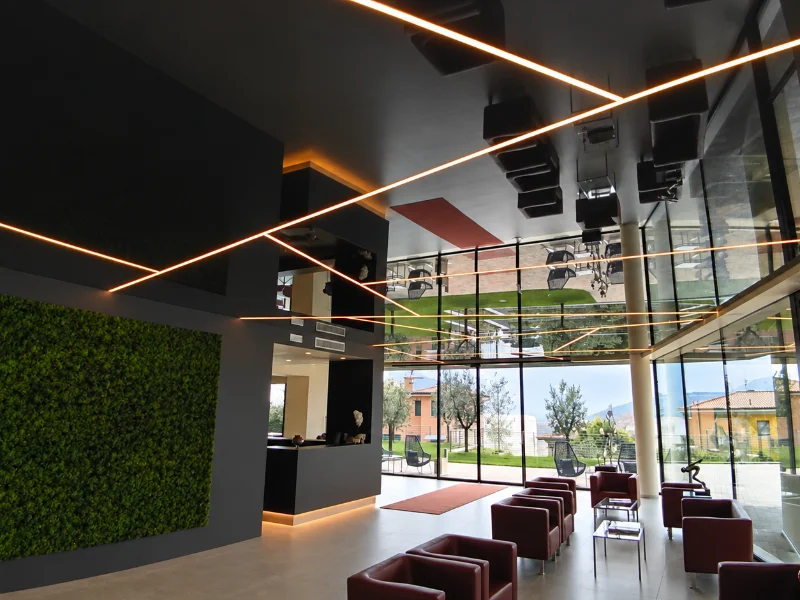
Acoustic Design: Why It Should Be Considered from the Early Stages of a Project
When designing a new environment or renovating an existing space, many aspects are taken into consideration from the very beginning: space planning, lighting, building systems, materials, furnishings and, of course, the project’s aesthetic identity. But what role does acoustics play?
Acoustic comfort often becomes a priority only once a space is actually in use and issues such as reverberation, background noise or poor speech intelligibility begin to emerge. Yet considering acoustic aspects from the outset makes it possible to address them in relation to the architecture, the intended use and the characteristics of the space.
This is precisely where acoustic design comes into play, requiring dedicated specialist expertise. Once the requirements have been identified and the acoustic objectives defined, the next step is to select the most suitable solutions for translating these specifications into the space.
This is where different areas of expertise can come together with a common goal: ensuring that acoustics, functionality and design work in harmony within the same project.
What is acoustic design?
Every space has different characteristics that influence how sound behaves within it. Dimensions, geometry, materials, surfaces and intended use are just some of the factors that come into play.
Acoustic design makes it possible to analyse these aspects and identify the requirements of a specific environment, defining the objectives to be achieved according to the activities that will take place within it.
A restaurant, for example, has different requirements from an office, just as a conference room cannot be assessed in the same way as an educational space. The activities, the number of people present, the way the space is used and how sound needs to be perceived all vary.
Acoustic design is therefore a specialist activity that should be entrusted to qualified professionals. The specifications resulting from this stage then become an important reference for the other professionals involved in the project and for the subsequent selection of sound-absorbing solutions.
Why consider acoustics from the outset?
Integrating acoustic aspects into the early stages of a project makes it possible to consider them as part of the overall vision for the space.
Materials, surfaces, space planning, furnishings and finishes are all choices that help define its identity. Understanding the acoustic requirements at an early stage allows the various professionals involved to take them into account within their respective areas of work.
This does not mean that it is impossible to intervene in an already completed space. Sound-absorbing systems can also be installed at a later stage to improve acoustic comfort within an environment.
Considering acoustics from the outset, however, makes it possible to address the subject in a coordinated way and to assess in advance how the necessary solutions can be integrated into the architecture.
In other words, acoustic comfort does not necessarily have to be treated as something to be added at the end: it can become part of the design process alongside the other elements that define the space.
Architect, designer, acoustic specialist and manufacturer: expertise working together
Creating an environment involves different professionals, each with a specific role.
Architects and designers work on the organisation, functionality and identity of the space; an acoustic specialist can handle technical assessments and acoustic design; while the manufacturer of sound-absorbing systems contributes its knowledge of solutions, materials and customisation options.
Keeping these roles distinct is important, but so is ensuring effective dialogue between them.
Once the acoustic requirements have been defined, the design specifications need to be translated into solutions that can actually be produced and successfully integrated into the environment.
This is where IsolDesign comes into play, supporting the professionals involved in selecting and developing sound-absorbing systems that are consistent with the identified requirements and the architectural characteristics of the space.
When acoustic comfort and aesthetics need to coexist
Once the acoustic requirements have been established, the question is not only which solution to use, but also how to integrate it into the environment.
A sound-absorbing system interacts with walls, ceilings, furnishings, lighting, materials and finishes. The technical component therefore needs to work in harmony with the aesthetic one.
There are numerous possibilities.
IsolDesign offers different types of sound-absorbing panels and systems, including solutions for walls, ceilings and suspended ceilings, as well as suspended elements and partitions. Shapes, colours, materials and finishes also provide a wide range of customisation options.
Depending on the project, the system can therefore become a visible and distinctive element of the interior design or blend more discreetly into the architecture.
Acoustic comfort and aesthetics do not necessarily need to be treated as two separate requirements: choosing the right solution makes it possible to bring them together.
Every project requires a different solution
If no two environments are exactly alike, there can be no single sound-absorbing solution that is equally suitable for every situation.
The requirements defined from an acoustic perspective provide an initial reference point, alongside the specific characteristics of the environment: available surfaces, spatial configuration, furnishings and building systems, materials and the desired aesthetic result.
In some cases, the wall may be the most suitable surface for installing panels; in others, it may be preferable to work on the ceiling or use suspended elements. In certain configurations, partition solutions may instead be the most appropriate option.
The choice therefore concerns not only the product itself, but also the relationship between the system and the space in which it will be installed.
This is precisely why dialogue between those who have defined the acoustic requirements, those developing the architectural project and those familiar with the characteristics of the available systems can be particularly important.
From acoustic design to the sound-absorbing solution
Acoustic design and the production of sound-absorbing systems are two distinct areas of expertise, but they can work together within the same project.
The former makes it possible to define the acoustic requirements and objectives of the space; the latter translates those specifications into tangible elements that can be produced and integrated into the environment.
It is at this second stage that IsolDesign brings its expertise into play.
The company manufactures and customises sound-absorbing panels and systems, working on the characteristics of each solution so that it can meet the identified requirements while integrating seamlessly into its architectural context.
Production and customisation, logistics and installation therefore accompany the system through to its effective integration into the space.
In this way, collaboration between different areas of expertise helps maintain a clear connection between what is required from an acoustic perspective and the solution that will ultimately be installed in the environment.
Integrating acoustics into the project from the outset
Considering acoustic design from the earliest stages does not mean entrusting every aspect of the work to a single professional. On the contrary, it means bringing different areas of expertise together while the project choices are still being defined.
The specialist identifies the acoustic requirements; architects and designers develop the space; and the manufacturer of sound-absorbing systems helps translate the specifications received into solutions that are compatible with the environment and its aesthetic identity.
It is precisely through the interaction of these different elements that acoustic comfort can become an integral part of the project, rather than something that is addressed only once the space has already been completed.
Do you have a project with specific acoustic requirements and are you looking for sound-absorbing systems that can be seamlessly integrated into your spaces? Contact IsolDesign to discuss your project with our team and identify customisable solutions tailored to its specific characteristics.
